

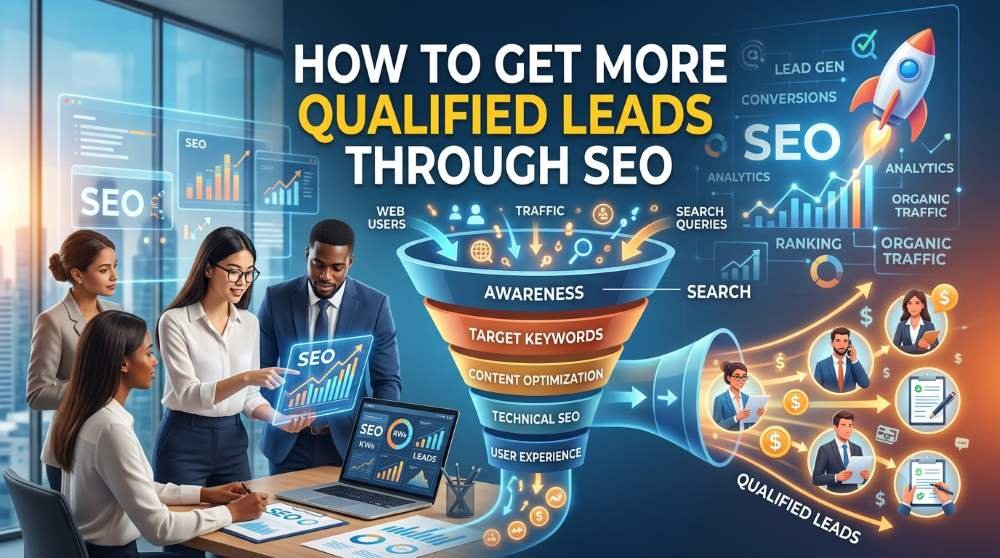
Getting more website traffic is not the ultimate goal of SEO. Getting the right people to visit your website and turn into customers is.
A website can receive thousands of monthly visitors and still generate very few leads if it ranks for the wrong keywords, targets the wrong audience, or fails to provide a clear path to conversion.
Effective SEO focuses on attracting people who are already searching for the products or services your business provides. When your website appears in front of these potential customers at the right stage of their buying journey, organic search can become one of your most reliable sources of qualified leads.
In this guide, we’ll explain how to use SEO to attract more qualified leads, improve conversion opportunities, and turn organic search traffic into measurable business growth.
What Are Qualified Leads?
A qualified lead is a potential customer who has a genuine interest in your product or service and is more likely to become a paying customer.
For example, someone searching for:
- “SEO agency for small business”
- “medical billing services for doctors”
- “commercial roofing company near me”
- “real estate agent in Northern Virginia”
is generally more valuable to the relevant business than someone searching for a broad informational term such as “what is SEO?”
The difference comes down to search intent.
A successful SEO strategy doesn’t simply increase the number of visitors to your website. It attracts visitors who have a problem you can solve, a service they need, or an intention to make a purchase.
SEO Traffic vs. Qualified SEO Leads
There is a major difference between increasing organic traffic and generating qualified leads.
Suppose your website receives 10,000 organic visitors per month but generates only 20 inquiries. Increasing traffic to 20,000 visitors won’t necessarily solve the problem.
Instead, you need to ask:
- Are we targeting the right keywords?
- Are our visitors actually interested in our services?
- Does our content match search intent?
- Are our service pages optimized for conversions?
- Are we targeting commercial and transactional searches?
- Is it easy for visitors to contact us?
- Are we measuring leads rather than just rankings?
The objective should be:
Relevant traffic → engaged visitors → qualified leads → customers
That’s where SEO becomes a growth channel rather than simply a traffic-generation tactic.
1. Target High-Intent Keywords
One of the most important ways to generate qualified leads through SEO is targeting keywords based on buyer intent.
Not every keyword has the same business value.
For example, someone searching for “SEO” could be researching the topic, looking for a job, comparing agencies, or trying to understand what SEO means.
Someone searching for “SEO company for small business” has a much clearer commercial intent.
Focus on Commercial Keywords
Commercial keywords often include terms such as:
- SEO company
- SEO agency
- SEO services
- local SEO services
- affordable SEO services
- best SEO company
- SEO consultant
- SEO services for small businesses
- professional SEO services
- SEO agency near me
These searches can be highly valuable because the searcher may already be evaluating providers.
However, don’t ignore informational keywords. Informational content can attract potential customers earlier in their buying journey and build trust before they are ready to contact you.
The strongest strategy combines informational, commercial, and transactional keywords.
2. Understand Search Intent Before Creating Content
Ranking for a keyword is not enough. Your content needs to satisfy what the searcher actually wants.
Search intent generally falls into four categories:
Informational Intent
The user wants to learn something.
Examples:
- What is technical SEO?
- How does local SEO work?
- How long does SEO take?
Navigational Intent
The user is looking for a specific website, company, or brand.
Examples:
- Tech Indexer SEO
- Tech Indexer reviews
- Tech Indexer services
Commercial Investigation
The user is researching options before making a decision.
Examples:
- best SEO agencies
- SEO company vs freelancer
- local SEO agency pricing
Transactional Intent
The user is ready to take action.
Examples:
- hire SEO agency
- SEO services for small business
- local SEO company near me
Your content strategy should cover each stage, but your service and landing pages should strongly focus on commercial and transactional intent.
3. Build Dedicated Service Pages
One of the biggest SEO mistakes businesses make is trying to rank their homepage for every service they offer.
Instead, create dedicated, highly relevant service pages.
For example, an SEO agency could have separate pages for:
- SEO Services
- Local SEO Services
- Technical SEO
- E-commerce SEO
- Enterprise SEO
- SEO Content Writing
- Google Business Profile Optimization
- SEO Audits
Each page can target a specific set of keywords and address the needs of a specific audience.
A well-optimized service page should clearly explain:
- What service you provide
- Who the service is for
- What problems you solve
- How your process works
- Why clients should choose you
- What results they can expect
- Frequently asked questions
- How to get started
This creates a much stronger path from Google search → relevant page → inquiry.
4. Create Content Around Your Customers’ Problems
People don’t always search for your service by name.
Sometimes they search for the problem they are experiencing.
For example, a business owner may not search for “SEO lead generation services.” They may search:
- Why is my website traffic dropping?
- Why isn’t my website generating leads?
- How can I rank higher on Google?
- Why is my competitor ranking above me?
- How can I get more customers from Google?
These searches represent opportunities to introduce your expertise.
Create useful content that answers these questions and then connect the reader to a relevant service.
For example:
Blog: Why Isn’t My Website Generating Leads?
↓
Related service: SEO Services
↓
CTA: Request an SEO consultation
This creates a natural conversion path instead of forcing a sales pitch into every article.
5. Use Topic Clusters to Build Authority
Publishing random blog posts isn’t enough to build a strong SEO presence.
Instead, organize your content around important topics and create topic clusters.
For example:
Pillar Topic: SEO Lead Generation
Supporting content could include:
- How to Get More Leads Through SEO
- How Keyword Research Improves Lead Generation
- SEO vs PPC for Lead Generation
- How Local SEO Generates Customers
- How to Optimize Service Pages for Leads
- How to Improve Organic Conversion Rates
- How Long Does SEO Take to Generate Leads?
Each supporting article can internally link to the main SEO service or lead-generation page.
This helps search engines understand your topical expertise while also moving users toward commercially valuable pages.
6. Optimize Your Website for Conversions
Getting visitors to your website is only half the job.
You also need to make it easy for them to take the next step.
Your website should have clear calls to action throughout the user journey.
Examples include:
Request an SEO Audit
Get a Free SEO Consultation
Talk to an SEO Expert
Request a Strategy
Get a Custom SEO Proposal
The CTA should match the visitor’s stage in the buying journey.
For example, someone reading an introductory SEO guide may not be ready to request a proposal. Offering an SEO checklist or audit can be a lower-friction conversion opportunity.
Someone visiting your SEO services page, however, may be much closer to making a decision.
7. Create Landing Pages for High-Value Audiences
Generic SEO pages may not be enough if your company serves different industries.
You can create targeted landing pages for specific audiences where there is genuine demand.
For example:
- SEO for Healthcare Companies
- SEO for Real Estate Companies
- SEO for SaaS Companies
- SEO for E-commerce Businesses
- SEO for Professional Services
- Local SEO for Small Businesses
These pages allow you to speak directly to the problems, goals, and search behavior of each audience.
Instead of saying:
“We provide SEO services.”
You can explain how your SEO strategy helps a particular type of business generate more relevant traffic, inquiries, appointments, or sales.
That level of relevance can significantly improve both SEO performance and conversions.
8. Strengthen Your Local SEO Strategy
If your business serves customers in specific cities or regions, local SEO can be an excellent source of qualified leads.
Optimize your:
- Google Business Profile
- Location pages
- Service-area pages
- Local citations
- Reviews
- Local backlinks
- On-page location signals
- Local business schema
Target keywords with geographic intent, such as:
- SEO company in [city]
- SEO agency near me
- local SEO services [city]
- digital marketing agency [city]
Local searchers are often closer to taking action because they are actively looking for a provider in their area.
9. Build Trust With Proof and Case Studies
SEO can generate visitors, but trust helps turn visitors into leads.
When someone lands on your website, they want to know:
Can this company actually deliver results?
Use evidence wherever possible, including:
- Case studies
- Client results
- Testimonials
- Reviews
- Before-and-after performance
- Organic traffic growth
- Keyword growth
- Lead-generation results
- Industry experience
Instead of simply saying:
“We are an experienced SEO company.”
Show visitors what you have accomplished.
For example, a case study showing how an SEO campaign increased qualified organic traffic and generated more inquiries is far more persuasive than a generic claim.
10. Improve Your Internal Linking
Internal links aren’t only useful for SEO. They can also guide visitors toward pages that generate revenue.
For example:
Blog post → Related blog → Service page → Contact page
When publishing a blog post, look for opportunities to naturally link to:
- Relevant services
- Industry pages
- Location pages
- Case studies
- Related articles
- Contact pages
Avoid adding internal links simply for the sake of adding them. Every link should provide value to the reader.
11. Optimize for AI Search and Answer Engines
Search behavior is changing.
People increasingly use AI-powered search and answer engines to research businesses, compare services, and find solutions.
Your SEO strategy should therefore focus not only on traditional rankings but also on becoming a reliable source of information that search engines and AI systems can understand.
Helpful practices include:
- Answering common customer questions clearly
- Creating well-structured content
- Demonstrating first-hand expertise
- Building topical authority
- Using descriptive headings
- Supporting important claims with trustworthy information
- Keeping business and service information consistent
- Creating comprehensive service and industry pages
The goal is simple:
Make your website one of the most useful and trustworthy resources in your market.
12. Track Leads, Not Just Rankings
One of the biggest mistakes in SEO reporting is focusing exclusively on keyword positions.
Ranking #1 is valuable, but it doesn’t automatically mean your business is growing.
Track metrics that connect SEO to revenue, including:
- Organic leads
- Contact form submissions
- Phone calls
- Consultation requests
- Quote requests
- Appointment bookings
- Organic conversion rate
- Qualified lead rate
- Revenue from organic search
For example:
Organic traffic: 8,000 visitors
Leads: 120
Qualified leads: 45
Customers: 15
This tells you much more about SEO performance than simply saying, “We rank for 500 keywords.”
13. Optimize Pages That Already Generate Traffic
You don’t always need to create more content.
Sometimes your biggest opportunity is improving pages that already receive organic traffic.
Look at pages that:
- Rank on page one or two
- Receive significant impressions
- Have a high click-through opportunity
- Generate some leads but could convert better
- Target valuable commercial keywords
Then improve their:
- Title tags
- Meta descriptions
- Content
- Search intent alignment
- Internal links
- Calls to action
- Trust signals
- Page speed
- User experience
Moving an existing page from position 8 to position 3 can sometimes produce more business value than publishing several new articles.
14. Create a Clear SEO Conversion Funnel
A successful SEO campaign should have a clear journey from search to sale.
A simple funnel could look like this:
Google Search
↓
SEO Content or Service Page
↓
Relevant Information
↓
Trust & Proof
↓
Clear CTA
↓
Lead
↓
Sales Conversation
↓
Customer
Every stage matters.
If your rankings are strong but your service page is weak, you may lose the lead.
If your website converts well but you target irrelevant keywords, you may not attract the right visitors.
SEO lead generation works when traffic, content, user experience, and conversion strategy work together.
Common SEO Mistakes That Reduce Lead Generation
Even businesses investing heavily in SEO can struggle to generate qualified leads because of a few common mistakes.
Targeting Only High-Volume Keywords
High search volume doesn’t necessarily mean high commercial value.
A keyword with 500 searches and strong buying intent can be more valuable than one with 50,000 searches and little business relevance.
Publishing Content Without a Strategy
Publishing hundreds of unrelated articles won’t automatically generate customers.
Every piece of content should have a purpose.
Ignoring Commercial Pages
Blogs can attract traffic, but service pages often convert visitors into customers.
Don’t build an entire SEO strategy around informational content.
Weak Calls to Action
If visitors don’t know what to do next, many will simply leave.
Measuring Traffic Instead of Business Results
Traffic is an SEO metric.
Leads, customers, and revenue are business metrics.
Your SEO strategy should ultimately connect the two.
How Long Does SEO Take to Generate Leads?
There is no universal timeline because SEO results depend on factors such as:
- Website authority
- Competition
- Industry
- Keyword difficulty
- Existing rankings
- Website quality
- Content quality
- Technical SEO
- Backlink profile
- Local competition
- SEO strategy and execution
Some websites can generate early leads from low-competition opportunities, while competitive markets may require a longer-term campaign.
The important thing is to focus on consistent growth in relevant visibility and qualified conversions, rather than expecting overnight results.
How Tech Indexer Can Help You Generate More Qualified Leads
SEO should do more than make your website visible on Google.
At Tech Indexer, we focus on building SEO strategies designed around business growth and lead generation.
Our approach can include:
- Technical SEO audits
- Keyword research
- Competitor analysis
- On-page SEO
- Content strategy
- Local SEO
- Link building
- Service page optimization
- Conversion-focused content
- Internal linking
- SEO performance tracking
- AI search optimization
Rather than chasing rankings for the sake of rankings, we focus on identifying the searches that matter to your business and building a strategy that connects those searches with your products or services.
Ready to Turn SEO Traffic Into Qualified Leads?
If your website is receiving traffic but not enough inquiries, the problem may not be traffic volume. You may need a better strategy for targeting search intent, optimizing your pages, and converting visitors into leads.
Tech Indexer can help you identify where your SEO strategy is losing potential customers and create a roadmap focused on qualified organic leads.
Request an SEO consultation today and find out how your website can generate more opportunities from organic search.
Frequently Asked Questions
How can SEO generate qualified leads?
SEO generates qualified leads by helping your website appear when potential customers search for products, services, or solutions related to your business. Targeting high-intent keywords and creating relevant landing pages can attract visitors who are more likely to become customers.
What keywords generate the most SEO leads?
Commercial and transactional keywords often have strong lead-generation potential because they indicate that a user is researching or looking to purchase a product or service. However, the best keywords depend on your industry, audience, location, and business goals.
Is SEO better than paid advertising for lead generation?
SEO and paid advertising can both generate leads. SEO can provide long-term organic visibility, while paid advertising can produce immediate traffic. Many businesses benefit from using both channels as part of a broader digital marketing strategy.
How do I convert SEO traffic into leads?
Improve the relevance of your landing pages, target the right search intent, use clear calls to action, add trust signals and case studies, improve user experience, and make it easy for visitors to contact your business.
Should I focus on traffic or leads?
Leads should be the primary business objective. Traffic is useful when it comes from the right audience, but large amounts of irrelevant traffic may produce little business value.
Can local SEO generate qualified leads?
Yes. Local SEO can help businesses appear when customers search for services in specific locations. Optimizing your Google Business Profile, local pages, reviews, citations, and location-focused content can help increase relevant local inquiries.